Escalation of Tensions in the Middle East
The Middle East is witnessing a dramatic escalation of hostilities following a series of strikes by Israel and the United States against Iran. These attacks have resulted in the death of Iran’s supreme leader, Ayatollah Ali Khamenei, marking a significant turning point in regional dynamics.
The Death of Ayatollah Khamenei
Iranian state media confirmed the death of 86-year-old Ayatollah Ali Khamenei on Saturday, after an air strike carried out by the U.S. and Israel. This attack was part of what is considered the most ambitious series of strikes on Iran in decades. The loss of Khamenei has left Iranians in a state of uncertainty, with many questioning the future direction of their country.
U.S. President Donald Trump defended the strikes, stating that they were aimed at ending a decades-long threat from Iran and ensuring it could not develop a nuclear weapon. He framed the operation as a necessary step to protect national security, despite his previous opposition to American involvement in overseas conflicts.
Israeli Strikes Targeting Iran’s Defense Systems
On Sunday morning, Israel’s military launched strikes targeting Iran’s ballistic missile and air defense systems. Iranian state media reported hearing an explosion in Tehran, indicating the impact of these attacks. In response to the initial strikes, Iran launched hundreds of missiles and drones, targeting U.S. troops in the region and cities in Israel and Arab countries aligned with Washington. This led to widespread flight cancellations across the region.
Impact on Civilian Infrastructure
The attacks have had a significant impact on civilian infrastructure. Dubai’s international airport and its landmark Burj Al Arab hotel sustained damage, with four people injured. Abu Dhabi Airports reported an incident at Zayed International Airport, resulting in one fatality involving an Asian national and seven injuries. However, the post was later deleted, raising questions about the accuracy of the information.
Concerns Over Oil Prices and Regional Stability
Tehran warned on Saturday that the Strait of Hormuz, a critical passage for global oil consumption, had been closed. This has raised concerns about a potential sharp increase in oil prices. The situation has further heightened tensions in the region, with fears of new risks for Americans and other foreign nationals.
Iran’s Threat of Retaliation
In a statement early on Sunday, Iran’s Islamic Revolutionary Guard Corps announced that the country’s armed forces would soon retaliate with their biggest offensive operation ever against U.S. bases and Israel. This warning signals a possible escalation in the conflict, with Iran vowing to respond to the attacks.
International Reactions
Iran’s ambassador to the United Nations, Amir Saeid Iravani, called for an emergency meeting of the UN Security Council on Saturday. He claimed that hundreds of civilians had been killed and injured in the U.S. and Israeli strikes. Iravani described Iran’s retaliatory attacks as a matter of self-defense, asserting that the bases of hostile forces are legitimate military targets.
U.N. Secretary-General Antonio Guterres expressed deep regret over the loss of life and called for an immediate cessation of hostilities. He lamented that an opportunity for diplomacy had been “squandered.”
Public Reactions in Iran
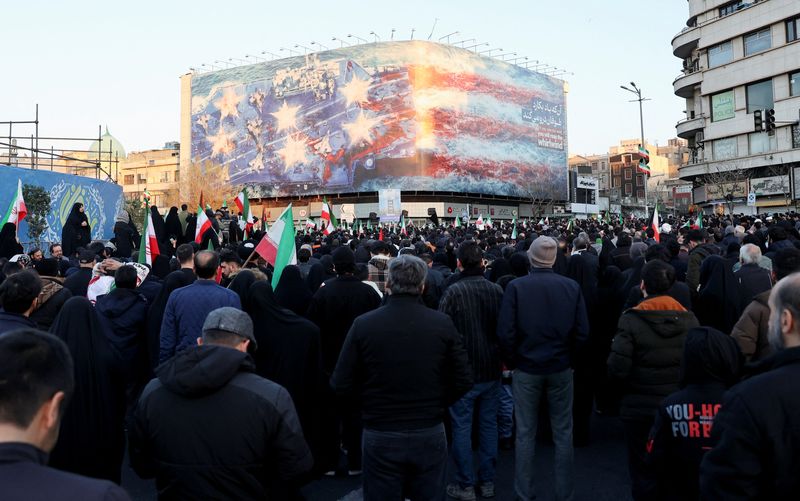
Witnesses reported that some Iranians took to the streets in Tehran, Karaj, and Isfahan to celebrate after reports of Khamenei’s death emerged. Videos posted on social media, which could not be verified, showed celebrations in other locations. This public reaction highlights the complex emotions surrounding the death of the supreme leader.
Strategic Timing of Attacks
Israel and the U.S. timed the attacks to coincide with a meeting of Khamenei and his top aides, according to two U.S. sources and a U.S. official familiar with the matter. Iranian state media reported that Khamenei was working in his office when the attack occurred, along with his daughter, grandchild, daughter-in-law, and son-in-law.
Implications for Iranian Leadership
The Revolutionary Guards issued a statement mourning the loss of “a great leader.” Meanwhile, Trump referred to Khamenei as “one of the most evil people in History” on social media. Trump and Israeli Prime Minister Benjamin Netanyahu called on Iranians to rise up and overthrow their government, citing the deaths of at least seven senior military commanders.
Long-Term Consequences
Experts suggest that while the deaths of Khamenei and other Iranian leaders would deal a major blow to the country, it may not necessarily end Iran’s entrenched clerical rule or the Revolutionary Guards’ influence over the population.
Failed Negotiations
Israeli military operations over the past two years have already targeted some of Iran’s senior military officials, weakening several of Tehran’s once-feared proxy forces. After a 12-day air war in June, joined by the U.S., the U.S. and Israel warned they would strike again if Iran continued its nuclear and ballistic missile programs.
During the UN Security Council meeting on Saturday, envoys from Russia and China criticized the U.S. and Israel for launching the strikes while Tehran was negotiating with Washington. Russia’s U.N. envoy Vasily Nebenzya claimed Iran had been “stabbed in the back” and disputed the U.S. claim that preventing Iran from acquiring a nuclear weapon justified the attacks.
Senior U.S. officials stated that the latest talks showed Iran was not willing to give up its ability to enrich uranium, which the Iranians argued was for nuclear energy, but U.S. officials believed would enable the country to build a nuclear bomb.